

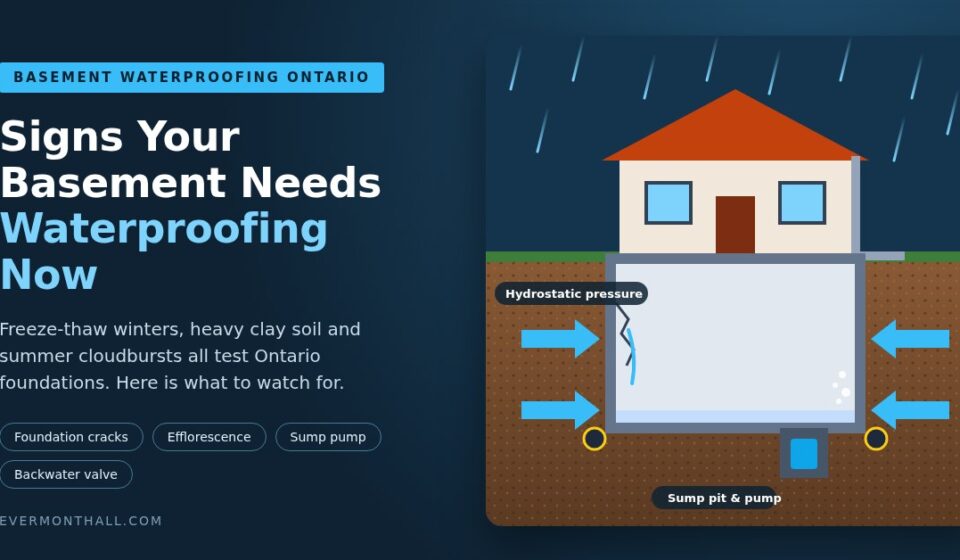

Most basement water problems don’t start with a flood. They start with a faint white crust on the block wall, a corner that smells like an old cottage, or a strip of carpet that never quite dries after a March thaw. Homeowners tend to shrug these off until the day there’s an inch of water around the furnace. If you own a house here, it pays to understand what basement waterproofing in Ontario actually involves, why our basements are especially vulnerable, and which warning signs mean you should act now rather than next spring.
Why Ontario basements take such a beating
A foundation in Ontario has a hard job. It sits in the ground through long, wet shoulder seasons, cold winters and increasingly violent summer storms. Three forces do most of the damage.
Freeze-thaw cycles
Water that soaks into the soil around your house, or into hairline cracks in the concrete, expands when it freezes. Over a winter that swings above and below zero again and again, that repeated expansion pries cracks wider and pushes on the wall. Frost-susceptible soil can also heave, nudging window wells, steps and walkways out of alignment so that they start directing water toward the house instead of away from it.
Clay soils that hold water
Much of southern Ontario is built on clay-rich soil. Clay drains slowly, so after a heavy rain or snowmelt the ground around a foundation can stay saturated for days. That trapped water presses against the walls and up under the slab. This is hydrostatic pressure, and it will find any weak spot: a tie-rod hole, the joint where the wall meets the floor, a crack around a pipe. Clay also swells when wet and shrinks when dry, which keeps the backfill moving year after year.
Storms that overwhelm the sewers
The third force has nothing to do with your walls at all. On July 16, 2024, Toronto Pearson recorded 97.8 mm of rain, the fifth-wettest day in the airport’s records. The City of Toronto received more than 700 calls to 311 about basement flooding, and the catastrophe data firm CatIQ later put insured losses from the July 15–16 flash flooding across southern Ontario at roughly $899 million. When municipal sewers fill faster than they can drain, water and sewage can push backward up the pipe into the lowest drain in your home. No amount of sealant on a wall will stop that.
Signs you need basement waterproofing in Ontario now
Some symptoms are cosmetic. Others mean water is already moving through the structure. These are the ones worth taking seriously.
White, chalky deposits on the walls
That powdery residue is efflorescence: mineral salts left behind when water passes through concrete or masonry and evaporates on the surface. Brushing it off doesn’t solve anything. It tells you moisture is travelling through the wall on a regular basis, even if you’ve never seen a puddle.
Cracks that leak, widen or run horizontally
Thin vertical shrinkage cracks are common in poured foundations and often stay dry for decades. Be more concerned about cracks that seep after rain, cracks that look wider this year than last, stair-step cracks in block walls, and especially horizontal cracks or a wall that bows inward. Those last two can point to soil pressure that needs a structural assessment, not just a patch.
A damp line where the wall meets the floor
The joint between the footing, wall and slab (often called the cove joint) is a natural weak point. Water pushed up by saturated soil frequently shows up here first as a dark band, a thin film after storms, or rust on the bottom of metal shelving.
A musty smell or a dehumidifier that never rests
If the basement smells stale no matter how often you clean, or your dehumidifier fills its bucket every day from spring to fall, there is a steady moisture source. Mould on drywall backing, baseboards or stored cardboard boxes confirms it.
Flooring and finishes that fail
Laminate that cups, vinyl tiles that lift, carpet tack strips that rot, paint that blisters and peels off the foundation wall: finishes fail from the back side when the concrete behind them stays wet. In a finished basement this is often the only visible clue until real damage has been done.
A sump pump that runs constantly, or not at all
A pump that cycles every few minutes during wet weather is telling you the water table around the house is high and your drainage is working hard. A pump that’s silent after a downpour may be failed, clogged or unplugged. Either situation deserves a closer look before the next big storm, not during it.
Gurgling floor drains and sewer odours
Water bubbling up through the floor drain, or a sewage smell after heavy rain, usually points to sewer surcharge or a partial blockage in your lateral rather than groundwater. That’s a plumbing problem first. If your drains are already slow, our guide to drainage cleaning and keeping household water flowing covers the basics worth ruling out.
What actually fixes the problem
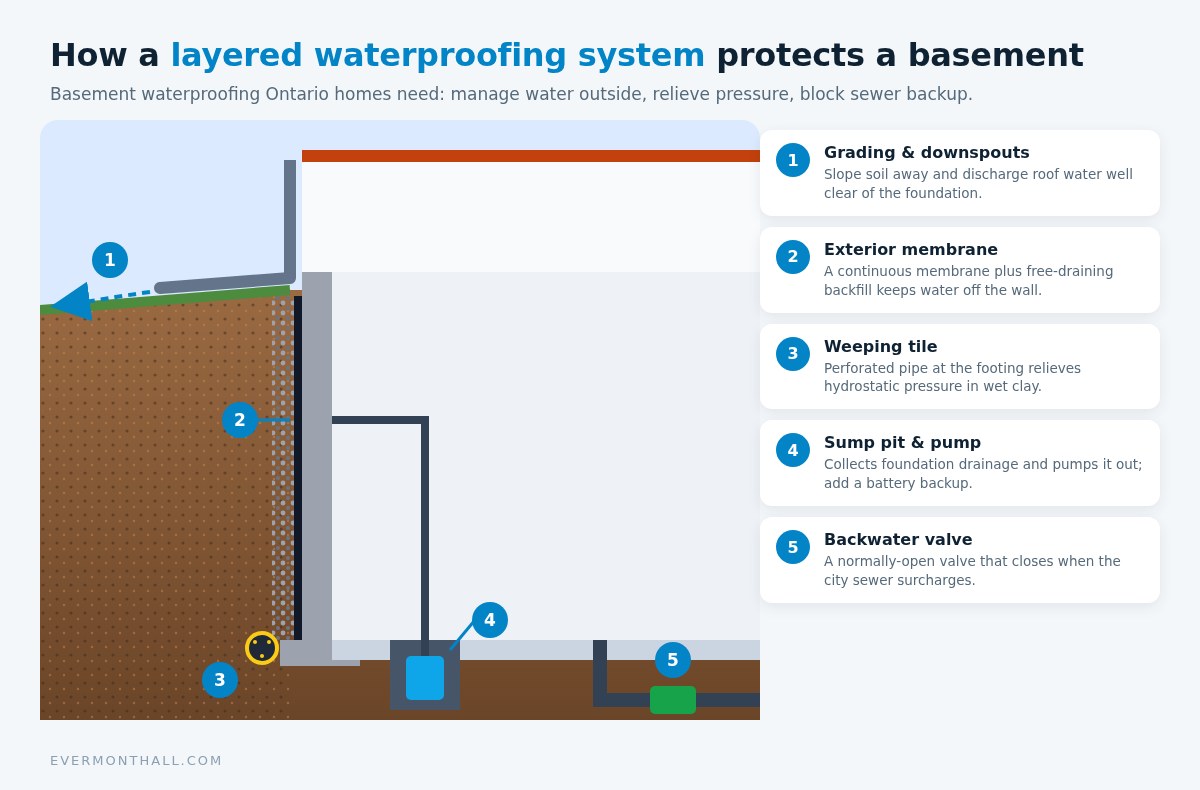
Good waterproofing is layered. The cheapest layers come first, and in many homes they solve most of the problem on their own.
Start outside the house
Walk around your foundation during a rainstorm. Look for downspouts that dump next to the wall, soil or patio stones that slope toward the house, and window wells packed with leaves. The City of Toronto recommends grading and extending downspouts so that water is directed at least 2 metres away from the foundation, and keeping window wells 10 to 15 cm above the ground, with covers where fire-escape rules allow.
Interior drainage and a sump pump
When water is entering at the cove joint or through the slab, an interior system is often the practical answer, particularly in finished basements or on tight urban lots where digging outside is difficult. A contractor cuts a channel around the perimeter of the floor, lays a perforated drain pipe in gravel, and routes the water to a sump pit where a pump discharges it outside. A battery backup is worth the extra cost, because storms and power outages tend to arrive together.
Exterior excavation and membrane
Digging down to the footings, repairing cracks, applying a continuous waterproofing membrane and replacing old or crushed weeping tile is the most thorough fix. It’s also the most disruptive and expensive, since landscaping, decks and walkways often have to come out. It makes the most sense for older homes with failing clay-tile weepers, for walls with active leaks along much of their length, or when you’re already planning major work. If a bigger renovation is on the table, read our piece on planning an older home renovation with Toronto contractors so the waterproofing is sequenced before new finishes go in.
Backwater valves and what the building code says
A backwater valve sits in the main sewer line and closes when municipal sewage tries to flow back into the house. Under section 7.4.6.4 of the Ontario Building Code, valves installed in a building drain must be a “normally open” type, and fixtures that sit below the level of the adjoining street, or below the upstream sanitary manhole cover, need backflow protection where the drain may be subject to backflow. Some municipalities go further. Ottawa, for example, requires backwater valves on the sanitary drain of all new single, semi-detached, row and townhouse units. Installing one in an existing home normally needs a plumbing permit, and the valve has to stay accessible: Toronto advises cleaning it every two to three months and before heavy rain.
City subsidies can cover a big share of the cost
Several Ontario municipalities pay homeowners to add flood protection, and the amounts have climbed recently. Toronto’s Basement Flooding Protection Subsidy Program was expanded on May 1, 2026, and now offers up to $6,650 per property for eligible work completed on or after November 12, 2025. That includes up to 80 per cent of the invoiced cost of backwater valves (to a maximum of $1,600 per device, for up to two devices), up to $2,250 for a sump pump, up to $300 for sump pump battery backup, up to $500 for a home plumbing assessment by a licensed plumber, and up to $400 for severing and capping a storm sewer or external weeping tile connection.
Ottawa’s Residential Protective Plumbing program rebates up to $1,000 for an indoor backwater valve, up to $2,500 for an outdoor storm backwater valve, up to $1,500 for a sump pump with battery backup in an existing pit and up to $3,000 where a new pit is built, along with the full plumbing permit fee. Eligibility rules, such as the age of the house, pre-approval and permit requirements, vary by city, so check your own municipality’s program before you sign a contract.
Check your insurance before the next storm
This is the part many people discover too late. According to the Insurance Bureau of Canada, a standard home policy generally covers sudden, accidental water damage from indoor plumbing, but damage from sewer backup is only covered if you’ve bought optional sewer backup coverage. Overland flood coverage, which can include groundwater and water seeping in through walls, is also optional. Call your broker, ask exactly which water endorsements you carry and what the limits are, and ask whether installing a backwater valve or sump pump could affect your premium or eligibility.
A fall checklist for Ontario homeowners
October is a smart time to do this, before the ground freezes and well before spring melt.
- Clear eavestroughs and downspouts, and extend the outlets well away from the walls.
- Check that soil and hard surfaces slope away from the house; top up low spots with soil, not mulch.
- Pour a bucket of water into the sump pit to confirm the pump starts, and test the backup.
- Open the backwater valve’s access cover and clear any debris.
- Photograph existing cracks with a tape measure beside them so you can tell if they grow over winter.
- Move valuables and documents off the basement floor and into sealed plastic bins.
If you spot efflorescence, damp cove joints, growing cracks or sewer odours, get a licensed plumber or a reputable waterproofing contractor to assess the house, and get more than one quote. Ask each contractor to explain where the water is coming from, not just what they’d install. The best basement waterproofing in Ontario homes is rarely a single product. It’s a combination of good grading, working drainage and backflow protection, matched to the soil and the street your house actually sits on.