


Most people spend weeks choosing a paint colour and about thirty seconds choosing the finish. They grab whatever the store clerk suggests, or whatever was on the last can in the garage, and only find out on day two that the “nice soft glow” in the hallway shows every roller lap, or that the flat paint in the kids’ room comes off with the crayon.
The finish, or sheen, decides how a wall looks in raking afternoon light, how well it survives fingerprints and wet boots, and how easy it is to touch up two years from now. Get it right and a mid-priced paint looks expensive. Get it wrong and even a premium colour can look patchy. Here is how the four interior paint finishes most homeowners choose between actually behave, and where each one earns its place.
What “sheen” really means
Sheen is simply how much light a dried paint film reflects back at you. Manufacturers measure it with a gloss meter, which bounces light off a sample at a fixed angle and reports a number. Low numbers mean a dull, light-scattering surface. High numbers mean a smooth, mirror-like one.
Two things follow from that, and they explain almost every decision below:
- Higher sheen means a tighter, harder surface. There are fewer microscopic peaks and valleys for dirt to settle into, so the wall wipes clean more easily and holds up better to moisture.
- Higher sheen also means more reflection. Light skims across the surface and exaggerates anything that isn’t perfectly flat: drywall seams, nail pops, old patches, uneven roller texture.
One caution before we go further. There is no industry-wide standard for what counts as “eggshell” or “satin.” One brand’s eggshell can look close to another brand’s satin. If you are matching an existing wall, bring a chip or check the old can rather than trusting the name alone.
Interior paint finishes compared, from flattest to shiniest
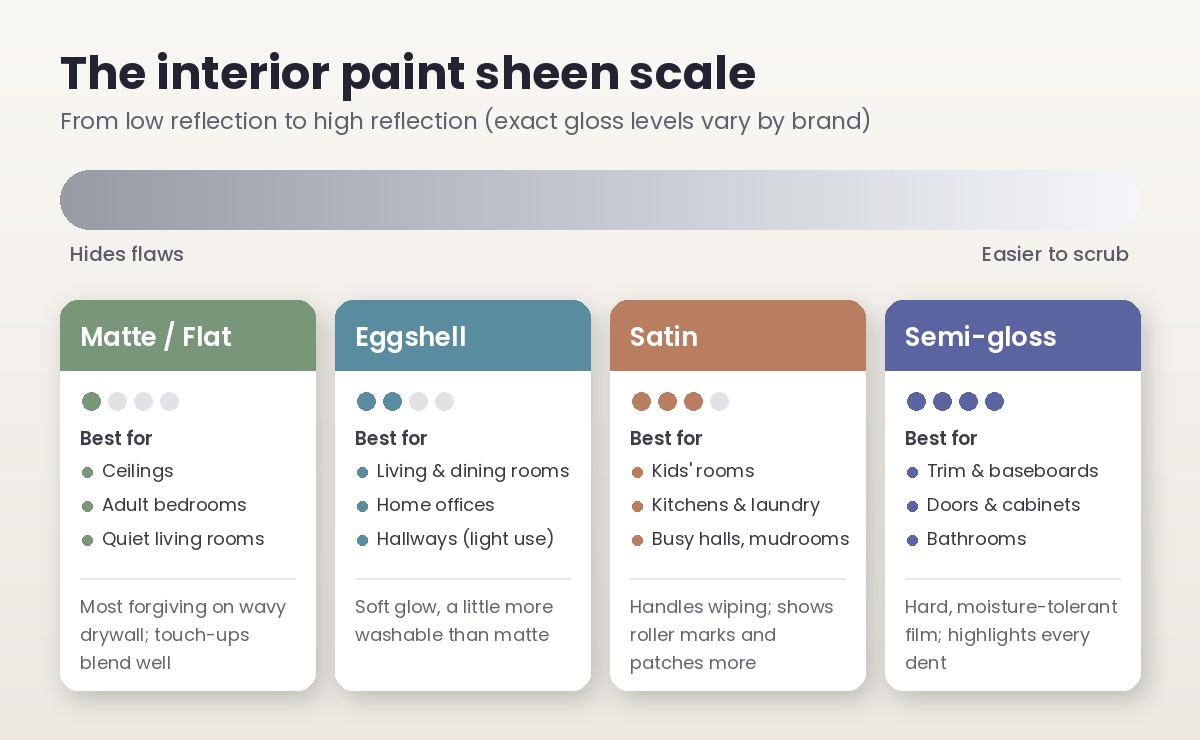
The chart below sums up the trade-off. Move right and you gain durability and washability; move left and you gain forgiveness.
Matte (and flat)
Flat and matte sit at the bottom of the scale. Some brands treat them as the same thing; others make “flat” slightly duller than “matte.” Either way, the surface scatters light, so colour looks rich and even, almost chalky in the best sense.
The big selling point is concealment. Older plaster walls, drywall that was taped in a hurry, a ceiling with a slight wave: matte smooths all of it over visually. Touch-ups are easier too. Dab a little matte paint on a scuff and it usually disappears, whereas the same patch in a shinier finish can “flash” and show up as a slightly different sheen.
The weakness is cleaning. Traditional flat paint can burnish (turn shiny) or lift if you scrub it. Many manufacturers now sell scrubbable or “washable” mattes that perform far better than flat paint did a decade ago, and they are worth the few extra dollars if you love the look but have kids or pets.
Use it on: ceilings, adult bedrooms, formal living rooms, and any wall with surface imperfections you’d rather not fix.
Eggshell
Eggshell has a faint lustre, roughly like the shell it’s named after. Stand straight in front of the wall and it reads almost matte. Look along it toward a window and you’ll notice a soft glow.
That small bump in sheen buys real practicality. Eggshell shrugs off light marks better than flat paint and survives a gentle wipe with a damp cloth. It still hides minor flaws reasonably well. That middle-ground personality is why many painters treat it as the default for living spaces.
Use it on: living and dining rooms, home offices, family rooms, and hallways that don’t see heavy traffic.
Satin
Satin is noticeably smoother and more reflective, with a pearly finish. It is the first sheen on the scale that is genuinely comfortable with regular cleaning, which makes it the workhorse for rooms where walls get touched, splashed or bumped.
The catch is application. Satin shows lap marks if you let the edge of one roller pass dry before you overlap it, and it highlights patched areas unless they are primed first. If you choose satin, plan on keeping a wet edge, rolling a full wall section without stopping, and spot-priming every repair.
Use it on: kids’ rooms, kitchens, laundry rooms, busy hallways and mudrooms.
Semi-gloss
Semi-gloss is bright and slick. It forms a hard film that resists moisture, grease and repeated scrubbing, which is exactly what you want on surfaces that get handled every day. It is also unforgiving: every dent in a baseboard and every brush stroke on a door will show.
On large wall areas semi-gloss can look a little institutional, so most homeowners reserve it for trim and woodwork, where the contrast against a lower-sheen wall actually makes rooms look crisper.
Use it on: baseboards, door and window casings, interior doors, cabinets, and bathroom walls in rooms that stay damp.
Choosing a finish room by room
If you want a quick starting point, this pairing works for most homes:
| Area | Typical finish | Why |
|---|---|---|
| Ceilings | Flat or matte | Hides texture and light glare from fixtures |
| Bedrooms | Matte or eggshell | Calm look, low traffic |
| Living and dining rooms | Eggshell (or washable matte) | Balance of looks and wipe-ability |
| Hallways and stairwells | Eggshell or satin | Hands, bags and shoulders brush the walls |
| Kitchens and laundry | Satin | Grease and splashes need regular cleaning |
| Bathrooms | Satin or semi-gloss | Humidity and condensation |
| Trim, doors, cabinets | Semi-gloss | Hard, scrubbable film on high-contact surfaces |
Treat that table as a default, not a rule. A bathroom with a strong exhaust fan and a window can handle a moisture-resistant matte. A dining room with fresh, level-five drywall can wear satin beautifully. The right answer depends on the condition of the surface and how the room is actually used.
A note for Canadian homes
Our climate adds a couple of wrinkles. Entryways and mudrooms take a beating from November to April, with wet boots, salt and hockey bags all landing against the same wall, so satin there pays for itself. Bathrooms see big swings in humidity when the heat is running and the windows stay shut, which argues for a higher sheen or a bathroom-specific paint. If you are already working through a fall home maintenance checklist, checking that bathroom fans actually vent outdoors will do as much for your paint as the finish you pick.
Light, colour and surface condition change the answer
Three factors can push you up or down the scale.
Light direction. Walls that run perpendicular to large windows get raking light, the low-angle sunlight that throws every bump into relief. These are the walls where a lower sheen pays off most. Hold a work light flat against the wall at night and you’ll see what the sun will show.
Colour depth. Dark, saturated colours read shinier than pale ones in the same finish, and they show scuffs and touch-ups more readily. A deep navy in eggshell can look closer to satin. Many painters drop one sheen level for very dark walls.
Surface condition. Be honest about your walls. If a room has years of patched picture-hanging holes, a satin finish will turn each repair into a small, visible halo unless you skim and prime properly. Owners of older houses run into this constantly, and it’s one reason people planning an older home renovation often budget for drywall repair before paint.
Practical tips before you open the can
- Sample on the actual wall. Paint two swatches at least 30 cm square, side by side, and look at them in morning, afternoon and lamp light before committing.
- Prime patches on anything above matte. Fresh filler absorbs paint differently, and that difference shows up as dull spots on satin and semi-gloss.
- Scuff glossy surfaces before repainting. If you are putting new paint over old semi-gloss trim, a light sand and a bonding primer help the new coat grip. If the house was built before 1978, test for lead before sanding; the U.S. EPA’s guidance on lead paint sources explains why older trim and windows deserve extra care.
- Keep a labelled touch-up jar. Write the brand, colour code, sheen and room on the lid. Matching the sheen later is harder than matching the colour.
- Ventilate while you work. Low-VOC paints are widely available, but any fresh paint releases some fumes as it cures. The EPA’s overview of volatile organic compounds is a useful read on keeping indoor air healthy during a project.
Common mistakes worth avoiding
Using one sheen for everything. It’s tempting to buy a single finish for walls, trim and ceilings to keep things simple. The result usually looks flat and tired, and the trim wears out fast. A two- or three-sheen system costs little more and looks far more finished.
Touching up a different sheen. Patching an eggshell wall with leftover satin will leave shiny blotches you can see from across the room. If you’ve lost the original can, repaint the wall from corner to corner instead.
Choosing high gloss to “make it last.” More sheen is more durable, but only if the surface is smooth enough to wear it. On imperfect drywall, a quality washable matte or eggshell will often look better for longer.
Ignoring the ceiling. Ceiling paint is usually flat for a reason. Anything shinier reflects light fixtures and shows every seam overhead.
The short version
If you only remember one thing, remember the trade-off: lower sheens hide flaws, higher sheens survive cleaning. Matte for ceilings and quiet rooms, eggshell for everyday living spaces, satin for rooms that get messy, and semi-gloss for trim, doors and damp areas. Test swatches in your own light, prep the surface to suit the finish, and label the leftovers. Do those things and your new paint job should still look sharp long after the drop cloths are folded away.
Related reading